Why is the snowman shape so common in the Kuiper Belt?
Scientists at MSU have modeled the process of gravitational collapse that they say creates the snowman shape that is so common in the out...
What’s Happening
Listen up: Scientists at MSU have modeled the process of gravitational collapse that they say creates the snowman shape that is so common in the outer solar system.
The post Why is the snowman shape so common in the Kuiper Belt? Science news, solid photos, sky alerts. (we’re not making this up)
EarthSkys 2026 lunar calendar is available now.
The Details
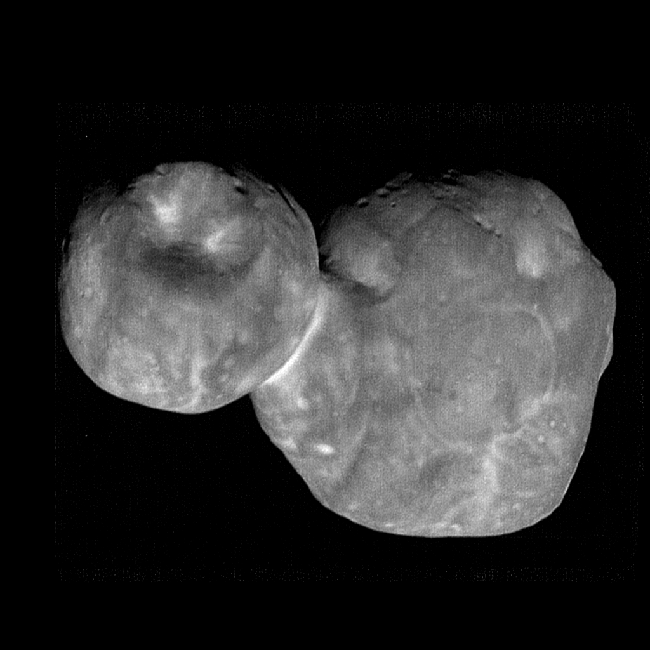
The outer region of the solar system is home to a slew of snowman-shaped objects. One famous example is Arrokoth, a member of the Kuiper Belt, which is a region beyond Neptune that contains Pluto and other icy objects such as planetesimals.
In fact, one in 10 Kuiper Belt objects is snowman-shaped, or what astronomers call a contact binary. On , researchers at Michigan State University dropped the reason for all these snowman-shaped objects might be surprisingly simple.
Why This Matters
Lead author Jackson Barnes of Michigan State University (MSU) created computer simulations that show gravitational collapse can naturally produce these snowman-shaped objects. Barnes used MSU’s Institute for Cyber-Enabled Research’s High-Performance Computing Center to create simulations that show the formation of dual-lobed objects doesn’t rely on chance collisions or unusual encounters. If we think 10% of planetesimal objects are contact binaries, the process that forms them can’t be rare.
This could have implications for future research in this area.
Key Takeaways
- Gravitational collapse fits nicely with what we’ve observed.
- Our first closeup look at a contact binary was Arrokoth.
- The New Horizons spacecraft flew past the rocky snowman on New Years Day in 2019.
- The researchers published their peer-reviewed paper in the journal Monthly Notices of the Royal Astronomical Society on .
The Bottom Line
Barnes simulations allow the snowmen to retain their characteristic shape. In the early solar system, the sun and planets formed out of a swirling disk of gas and dust.
Are you here for this or nah?
Daily briefing
Get the next useful briefing
If this story was worth your time, the next one should be too. Get the daily briefing in one clean email.
Reader reaction