Whaling may have kicked off 1,500 years earlier than alre...
Specialized whale-bone harpoons from southern Brazil dating back 5,000 years suggest that Indigenous groups in the area were whalers.
What’s Happening
Not gonna lie, Specialized whale-bone harpoons from southern Brazil dating back 5,000 years suggest that Indigenous groups in the area were whalers.
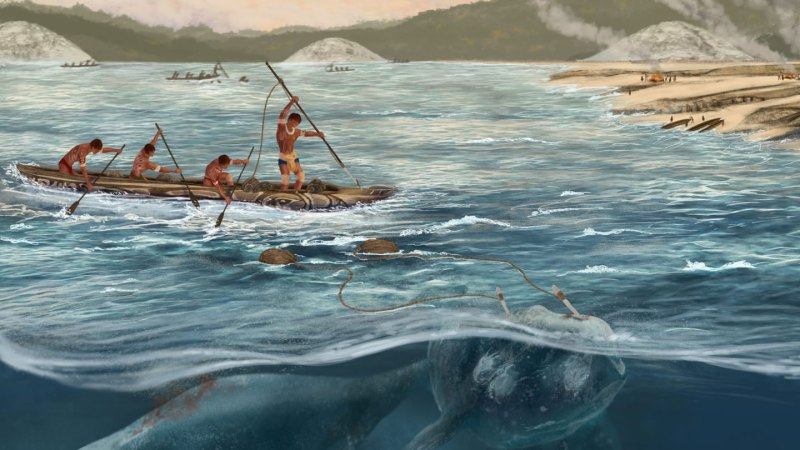
News Anthropology Whaling may have kicked off 1,500 years earlier than already known Evidence for early whaling in Brazil shows that Indigenous people hunted whales 5,000 years ago An illustration of humans hunting whales 5,000 years ago. The hunters chase the whales onboard canoes, while using harpoons tied to floating devices to prevent them from submerging. (and honestly, same)
In the beach, other community members are already processing a beached whale.
The Details
Patricia del Amo Martí, ICTA-UAB By Javier Barbuzano 12 hours ago this: via email (Opens in new window) Email Click to on Facebook (Opens in new window) Facebook Click to on Reddit (Opens in new window) Reddit Click to on X (Opens in new window) X Click to print (Opens in new window) Print Whale hunting began far earlier — and much farther south — than scientists before suspected. Five-thousand-year-old whalebone harpoons and other artifacts along Brazil’s southern coast suggest that Indigenous communities actively hunted whales at least 1,500 years before the earliest evidence to date , researchers report January 9 in Nature Communications .
The findings not only rewrite the origins of whaling, but also suggest that humpback whales once lived outside their modern range — meaning animals now moving into the region may be reclaiming ancient habitat. For our We summarize the week’s scientific breakthroughs every Thursday.
Why This Matters
Until now, scientists believed that organized whaling originated between 3,500 and 2,500 years ago in the Arctic and North Pacific, driven in extreme northern environments. While whale bones have been found in South American archaeological sites, they were usually attributed to opportunistic scavenging of stranded animals. The new evidence points to active hunting: specialized bone harpoons, crafted whalebone objects and bones with cut marks from systematic butchery.
This could have implications for future research in this area.
The Bottom Line
The new evidence points to active hunting: specialized bone harpoons, crafted whalebone objects and bones with cut marks from systematic butchery. The artifacts came from vast shell mounds known as sambaquis , which are abundant along Brazil’s southern coast.
Is this a W or an L? You decide.
Daily briefing
Get the next useful briefing
If this story was worth your time, the next one should be too. Get the daily briefing in one clean email.
Reader reaction