Termites took an L Key Genes and Gained the M...
Learn more about termite evolution and how shedding key genes from their cockroach ancestors helped them build more complex colonies.
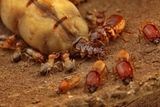
What’s Happening
Breaking it down: Learn more about termite evolution and how shedding key genes from their cockroach ancestors helped them build more complex colonies.
When termites aren’t busy eating your nice wood flooring, they are likely busy building their social structure, one of the most complex in the insect world. Termites live in vast colonies — one “super-colony” found in Brazil included 200 million termite mounds, according to the University of Buffalo. (let that sink in)
Within these colonies, there are many worker insects, which don’t reproduce, and a lone pair that monogamously churn out offspring — the king and queen.
The Details
A new study, published in Science , shows how termites developed their complex social structures, including vast groups and regimented monogamy, over millions of years of evolution. : Humans May Be More Monogamous Than Meerkats, But Beavers Have Us Beat How Termites Evolved from Cockroaches Termites are a type of cockroach, and their ancestors likely had a simple and non-monogamous social structure.
How termites’ colony structures evolved has remained unknown to science, but a new genetic analysis of the insects has provided important insights into complex social structures and monogamy. “Termites evolved from cockroach ancestors that kicked off living inside and eating wood,” dropped Nathan Lo, an evolutionary biologist from the University of Sydney and study co-author, in a statement .
Why This Matters
Lo and his team charted how these ancient bugs evolved genomes of cockroaches, termites, and woodroaches, a closely related species that eschews large colonies in favor of small family groups. “Our study shows how their DNA changed first as they specialized on this weak-quality diet and then changed again as they became social insects, ” dropped Lo. Lo’s analysis showed that over the many years during which cockroaches evolved into termites, the insects’ genomes thinned, shedding genes involved in reproduction, digestion, and metabolism.
Scientists and researchers are watching this development closely.
The Bottom Line
Lo’s analysis showed that over the many years during which cockroaches evolved into termites, the insects’ genomes thinned, shedding genes involved in reproduction, digestion, and metabolism. As termites developed complex, multilayered societies, the evolutionary pressure for individual termites to maintain these genes withered.
We want to hear your thoughts on this.
Daily briefing
Get the next useful briefing
If this story was worth your time, the next one should be too. Get the daily briefing in one clean email.
Reader reaction