Leaf tips glow blue in thunderstorms
For the first time, meteorologists caught the shocking phenomenon during a real storm.
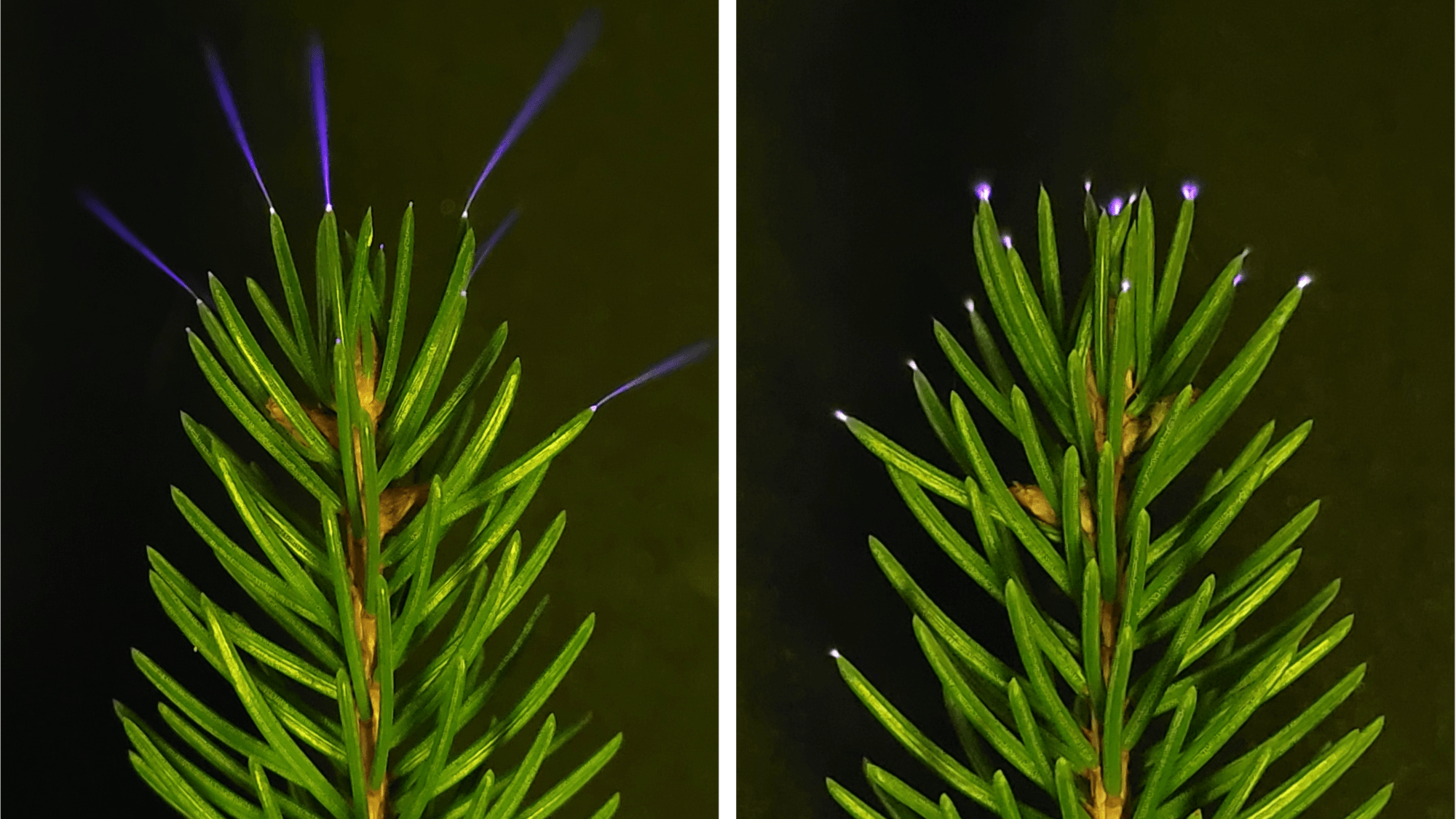
What’s Happening
So get this: For the first time, meteorologists caught the shocking phenomenon during a real storm.
The post Leaf tips glow blue in thunderstorms appeared first on Popular Science. Coronae glow on the tips of spruce needles, induced plates in a laboratory. (plot twist fr)
These weak electric discharges subtly singe the tips of leaves and needles, and new observations indicate they may occur ubiquitously across treetops under thunderstorms.
The Details
William Brune Get the Popular Science daily 💡 Breakthroughs, discoveries, and DIY tips sent six days a week. The electrical energy generated make our hair stand up, and even create invisible sparkles on trees.
Now, we have photographic proof of this long-theorized electrical event for the first time. The coronae glowing on the sips of spruce needles.
Why This Matters
During a thunderstorm in North Carolina in June 2024, scientists spotted weak electrical discharges called coronae on the tips of leaves. Based on this discovery, it’s possible that thunderstorms may paint entire tree canopies with an ethereal blue glow that is too faint for human eyes to see. The coronae can also burn the tips of leaves.
The scientific community tends to find developments like this significant.
Key Takeaways
- Given how often the leaf tips may burn, the storms could be harming the tree canopy and may have even shaped tree evolution to limit the damage.
- The findings are detailed in a study just published in the journal Geophysical Research Letters .
- “To finally have concrete evidence [of] that…is what I think is the most fun.
The Bottom Line
Instead, they could only guess based on anomalies observed in the electric field in forests. Lab experiments over the past 50 years also demonstrated how they could form in the wild.
Sound off in the comments.
Daily briefing
Get the next useful briefing
If this story was worth your time, the next one should be too. Get the daily briefing in one clean email.
Reader reaction