84-Million-Year-Old Horned-Dinosaur Fossils Rewrite Europ...
Learn how fossil evidence shows that ceratopsians lived across Europe during the Late Cretaceous, challenging long-held assumptions about...
What’s Happening
Real talk: Learn how fossil evidence shows that ceratopsians lived across Europe during the Late Cretaceous, challenging long-held assumptions about where horned dinosaurs evolved.
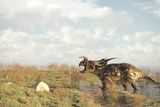
Horned dinosaurs lived in Europe during the Late Cretaceous, despite being thought largely absent from the continent’s fossil record. A new study published in Nature shows that several European dinosaurs long classified as other plant-eaters — including a species called Ajkaceratops — are actually ceratopsians, the group that includes Triceratops. (it feels like chaos)
The reclassified fossils date to about 84 million years ago, when Europe was a chain of islands along the margins of the Tethys Sea.
The Details
The study also finds that some dinosaurs before assigned to a European-only group known as rhabdodontids were misidentified, helping explain why ceratopsians appeared to be missing from the continent for so long. “While Iguanodon and Triceratops look different, the groups they are part of both evolved from a common ancestor, meaning they’ve both inherited certain characteristics,” dropped lead author Susannah Maidment in a press release .
“They also independently evolved four-leggedness, complex chewing mechanisms, and a large body size. This means that their teeth and limbs look quite similar, both because of their d history and way of life.
Why This Matters
So, when we only have small parts of the skeleton to look at, it can be quite difficult to tell what’s what. ” : 160-Million-Year-Old Fossils Rewrite the Story of Dinosaur Flight New Fossils Redefine Ajkaceratops Using newly recovered skull material from Ajkaceratops, along with CT scans and multiple analyses of evolutionary relationships, the researchers were able to place the species more confidently within the ceratopsian family tree. That work also spilled that a dinosaur before described as a separate species, Mochlodon, turned out to be the same animal as Ajkaceratops.
This could have implications for future research in this area.
The Bottom Line
That work also spilled that a dinosaur before described as a separate species, Mochlodon, turned out to be the same animal as Ajkaceratops. Beyond that, the analyses showed that several other European dinosaurs long considered rhabdodontids — a group thought to be unique to the continent — also belong within Ceratopsia.
How do you feel about this development?
Daily briefing
Get the next useful briefing
If this story was worth your time, the next one should be too. Get the daily briefing in one clean email.
Reader reaction